
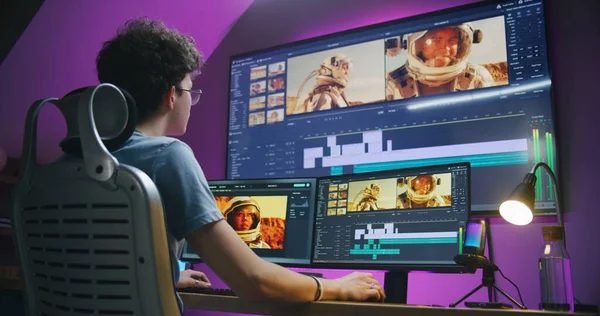
Video editing has traditionally required people to learn the language of timelines, tracks, keyframes, transitions, cuts, and export settings. Even simple changes often meant knowing exactly which tool to select and where to find it.
That relationship is beginning to change. AI-assisted editing tools are introducing another way to work: describe the result in ordinary language and let the software translate that instruction into editing actions.
Instead of thinking only in commands such as “cut at 00:14,” a creator can increasingly express intent: “Make this opening shorter,” “use the strongest moments first,” or “give this section a quicker pace.”
That sounds like a small interface change, but it could significantly change how people approach the first stages of editing.
Video Editing Is Moving From Commands to Intent
Traditional editing software asks the user to understand the action before performing it. If a sequence feels slow, the editor must decide what needs trimming, shortening, rearranging, or removing.
Natural-language editing introduces a different starting point. The user can describe the problem first.
For example:
- “Remove the pauses from this section.”
- “Make the introduction feel faster.”
- “Keep the clips where the speaker discusses the product.”
- “Turn these clips into a one-minute summary.”
- “Put the most energetic footage near the beginning.”
The First Cut Is an Obvious Place for AI Assistance
Building a rough cut can involve reviewing footage, identifying useful moments, removing unnecessary material, deciding clip order, and establishing an initial rhythm.
These jobs take time, but many of them can begin with relatively clear instructions.
CapCut × Codex, for example, is built around a workflow where users provide existing footage and describe the desired edit. The system can help review clips, identify useful sections, remove unwanted material, arrange footage, and create an editable rough cut that can then be refined in CapCut.
People looking for a ChatGPT video editor online are therefore often interested in something broader than automatic video generation. The practical value can be the ability to communicate editing intentions conversationally and get a workable starting point instead of beginning with an empty timeline.
Importantly, the resulting draft does not need to be treated as the finished video.
Everyday Language Makes Iteration Easier
Natural-language editing may also change how creators revise their work.
Consider the difference between identifying five individual cuts manually and simply noticing that “this section drags.” The second observation is how people naturally think about creative work.
An AI-assisted workflow can potentially translate that feedback into suggested changes. The creator can then inspect what happened and decide whether it actually improved the sequence.
This creates a more conversational editing cycle:
- Describe the intended result.
- Generate or adjust a draft.
- Watch the result.
- Identify what still feels wrong.
- Give another instruction or make manual changes.
Better Prompts Still Require Better Decisions
Natural language does not remove the need for editing judgment.
“Make it faster” sounds straightforward, but faster could mean several things. Should pauses disappear? Should shots become shorter? Should the introduction be removed? Should the music change? Should the entire story be reorganized?
AI can interpret the request, but the creator still needs to decide whether the interpretation works.
The same applies to clip selection. An automated system might identify footage that appears technically useful, while a human editor may prefer another take because of emotion, context, humor, timing, or narrative importance.
CapCut itself describes its Codex workflow as assistance for planning, drafting, and repetitive production work rather than a replacement for creative judgment. Users can continue adjusting story, timing, visuals, text, audio, and format after the first draft is produced.
The Skill Is Shifting, Not Disappearing
AI-assisted editing does not necessarily mean editing skills become irrelevant. Instead, some of those skills may shift.
Creators still need to understand pacing, audience attention, storytelling, visual continuity, sound, and context. What changes is how those decisions reach the timeline.
Rather than performing every mechanical step personally, an editor may increasingly describe the desired result, review what the software produces, and make more focused corrections.
That could make video editing more approachable without making it completely automatic.
Conclusion
Video editing software once expected users to speak its language. Natural-language tools are beginning to reverse that relationship.
Commands such as “trim this clip” are evolving into instructions such as “make this section tighter” or “start with the strongest moment.” The software handles more of the translation between intention and action, while the creator remains responsible for deciding whether the result actually works.
The biggest change, then, may not be that AI edits videos by itself. It is that editing is gradually becoming something people can explain in the same everyday language they use to describe what they want viewers to see and feel.