

Riga, January. Someone from a Helsinki operator said something we keep coming back to. The topic of artificial intelligence came up, and he talked about the time when everyone was using the term “cloud-powered” on every slide of their presentations. Then, at some point, nobody said it anymore. I just assumed. “Nobody announces the pipes,” he said.
Everyone at the table got it.
That’s where gambling is right now. The market is growing and will reach $600 billion in total. Online shopping makes up about $101 billion of that. But what’s more interesting is what actually happened over the last four years versus what everyone said would happen. The most hyped stuff was a big letdown. The things that nobody paid much attention to got really big. Finland became a major player in the European gambling industry, but most people outside the industry didn’t notice. In some countries, it’s now hard to tell the difference between a sports bet and a financial trade. This is not a figure of speech. In 2025, the courts had to make a decision about it.
We’ve been reporting on this topic for some time. Here’s what we’re watching.
AI Is Now the Pipes
If you go to a product meeting for a serious operator in 2026, you will see that AI will not be on the agenda. It’s not because they dropped it. It runs identity checks, monitors problem gambling, and decides which lobby version you see when you log in. Now, nobody talks about any of that on its own. In the same way, nobody mentions that the office runs on electricity.
KYC is the clearest example of this.
Two years ago, a new player could wait two or three days for a document at some operators. They weren’t going to stop gambling. They were quitting the wait. Most licensed platforms now clear a new account in less than two minutes. The rules say that money laundering screening, source of funds, and everything else is required. The number of sign-ups increased when the wait went away. That makes sense. If you cut the delay, people will stay.
GambleAware published data in 2025: 74% of players later identified as high-risk had already changed how they played, on average 14 days before they told anyone. The data was there the whole time. Kindred and a few others built real-time monitoring, and now someone reaches those accounts within hours. Playscan found that there were 31% fewer recorded harmful incidents between 2022 and 2024.
That number is hardly ever talked about.
Then there’s the lobby. Log in now and you’ll see something different from your neighbor. The platform builds your view around your device, how you got there, and what you did last time. Optimove tested this with 22 operators. The first-deposit conversion rate was 61.4% for the personal version and 45.7% for the one-size-fits-all version. On the personal side, the 30-day retention rate increased by 51%.
We now think about casino apps the same way we think about YouTube. You’re not seeing the product. You’re seeing your share of it.
It’s important to know that the system that finds you a good deal also knows exactly when you’re likely to deposit. Both come from the same data. The operator’s choice is a business decision, not a technical one. It doesn’t get much attention, but it should.
Gambling Looks More Like TV Than It Used To
We spoke with a sportsbook executive in London last October. We’re being careful not to name him. The main disagreement at his company right now is about whether they should be developing a gambling product or a TV product.
The people who are using it the most aren’t calling themselves “gamblers.” They say they watch a show.
This is not a joke. He was talking about a real crisis that his legal, product, and marketing teams each handle differently. This is part of the reason why it’s hard to fix.
By the start of Q1 2026, Livespins had 340,000 registered users. It’s not a big number on its own. But it will be faster than any other new format that is released by big companies before 2025. Those companies are developing their own versions quickly. You bet next to streamers. The result is the same as when someone with a large audience watches them react when it lands. The point of the bet is kind of irrelevant. It’s just a different kind of gambling than what we’ve seen for the last twenty years.
Nobody has figured out what responsible gambling rules mean for online casinos yet.
The missions and points layer is also moving quickly. It has features like leaderboards, weekly goals, and group challenges that are similar to those in Fortnite, Roblox, and other popular games. It’s now a common feature in the major European mobile sportsbook apps. For example, a player who was going to place six bets might end up placing nine if the ninth bet is the last one of the week. It’s not subtle at all. It works anyway.
Watch-party betting is where this ends up. You can stream the game inside the app and place small bets on the same screen while a group of people watch together. Some operators are running it in a small way. Most people haven’t.
Open Banking Fixed the Affordability Check Nobody Liked
The 2023 affordability check made almost everyone unhappy. Players didn’t like having to do extra steps. Operators weren’t happy with the effect it had on the number of people signing up. The rollout was a mess. Even two years later, people at conferences were still angry about it.
The rule itself didn’t change.
Open banking just made that same check disappear. A bank connection can clear it in seconds, instead of asking players to send three months of statements and wait. You only have to agree once. It goes through. Most people don’t even notice it ran.
We did the whole signup process with a UK operator last September. The first bet was downloaded seven minutes and forty seconds before the full checks were completed. Two years earlier, the same path took three days. Document queues. The rule didn’t change. The tools finally got faster.
We also noticed that stablecoins were being used more often than Bitcoin for cross-border payments on licensed platforms. The price swings problem is gone. Speed stayed the same. Some big companies are testing a system that lets you use points you earn at a physical casino to spend on a sports bet through the app. It’s not a big launch. They’re just running it.

Finland, Kalshi, and Brazil
Finland ended its state gambling monopoly, and we talked to three operators in the weeks after. None of them were surprised. The industry had been discussing it for two years. The operators who were serious had Finnish-language support, local payment connections, and legal setup done before the licensing rules even came out. Veikkaus was never a strong product. The gray market was big enough to show that there was real demand. When the monopoly ended, it didn’t result in the creation of new players. It just moved the ones already playing somewhere legal.
The operators who were ready on day one got the first wave. Everyone who was planning to deal with Finland is still behind schedule.
The Kalshi story is still developing.
After a series of court decisions in the US in 2025, Kalshi and Polymarket were recognized as financial instruments, not gambling, in several countries. This was for events like elections, inflation numbers, and real-world results. By the first quarter of 2026, major legal sportsbooks were starting to offer these bets alongside regular sports markets. You can now bet on whether the Fed raises rates using the same app as a Premier League parlay. Some countries are still figuring out what any of this means for their tax and gambling laws.
Brazil is the fastest market launch we’ve ever seen.
People spent a total of $2.3 billion on sports betting in the first six months after sports betting became legal in the early months of 2025. We were in São Paulo in October. The advertising was unlike anything we’ve ever seen at a market launch. Bus stops, TV breaks, football shirts, and stadium boards, all at once. The operators with local partners from day one were ahead of everyone still working on licensing.
India is a bigger potential story and still waiting. As of March 2026, there were 14 different state systems running at different speeds, and there was no national rule yet. KPMG estimated the market size at $8.4 billion. Operators are now building India products, including local cards, regional languages, and cricket-focused content. I’m willing to bet that a national framework will be created within the next two to three years. Some of these predictions will be right.
A Wincraft real money casino going into newly legal markets runs into all of this head-on. Operators who sort the legal side out before launch, not after, consistently come out of year one ahead.
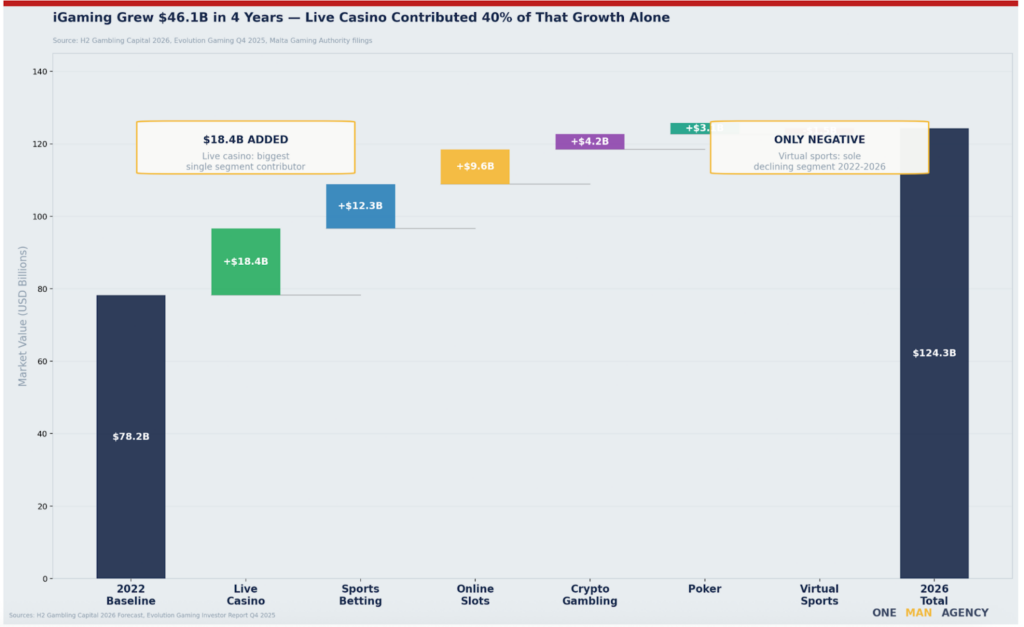
Live Casino Is Still the Machine
Evolution Gaming’s live dealer revenue increased by 31% compared to last year. This is the sixth year in a row that the growth has been above 10%. It had a 73.4% market share going into the second quarter (Q2) of 2026. Second place is not close.
I’m not trying to be a novelty. That story ended years ago.
What we think it actually is: trust. A player who sees a real person deal real cards at a real table feels differently about the outcome than someone who sees a computer run it on a screen they can’t check. That feeling isn’t logical. Players spend more time playing live games than regular digital games. The money is substantial.
Crazy Time from Evolution received $2.1 billion in bets across 2025, according to records from the Malta Gaming Authority. Imagine a live broadcast of Wheel of Fortune. Real hosts. There are six bet types that are active at the same time. The manager in London who told us that the users who are growing fastest see themselves as viewers, not gamblers — he was mostly talking about Crazy Time. They call it a show. The betting is less important than the show itself. This attracts people who traditional casinos have never reached.

What Flopped
Metaverse gambling. There will be a lot of energy at conferences in 2022 and 2023. In 2026, there will be basically no users. We’ve launched products that nobody’s using. You need a good VR headset just to open the thing. The people who gamble aren’t doing that.
Virtual sports continued through 2020 and 2021 when live sports stopped. When live sports returned, virtual sports went back to being shown when there was nothing else on. The show didn’t have a regular audience.
Since Nevada started taking skill-based slots seriously in 2018, many have been launched and then canceled. The problem is simple: people who want to play video games for fun are playing. People who play slots don’t want to use their skills. Years ago, the Nevada Gaming Control Board did some research that clearly showed this. Operators kept building them anyway.
In 2026, the total amount of money bet on esports was about $3 billion. This was much lower than the expected amount of $8 to $10 billion. The audience is there. It was harder than expected to get the audience to spend money. People watch, but they don’t bet. The difference between the two numbers was bigger than it looked. This is what happens when a forecast starts from the number of people who will watch and assumes that everyone in that audience will pay.